
Medication Adherence: The Role of Packaging
Up to 70% of patients in Canada do not take their medications as directed, depending on the condition.¹*
Despite advances in treatment, medication adherence remains a significant challenge for the healthcare system.
There are many reasons for medication non-adherence. Yet one factor is too often left out of the conversation, even though it is present every time medication is taken: packaging.
Quick Navigation
- Main causes and consequences of medication non-adherence
- Can packaging be a barrier to medication adherence?
- The safety-accessibility paradox
- Our solution
- Frequently Asked Questions
What is medication non-adherence?
Medication non-adherence occurs when a patient does not follow their treatment as prescribed. It can take many forms, including forgetting or skipping a dose, intentionally reducing the dosage, or stopping treatment early.
It can be occasional or progressive, intentional or unintentional.
Main causes and consequences of medication non-adherence
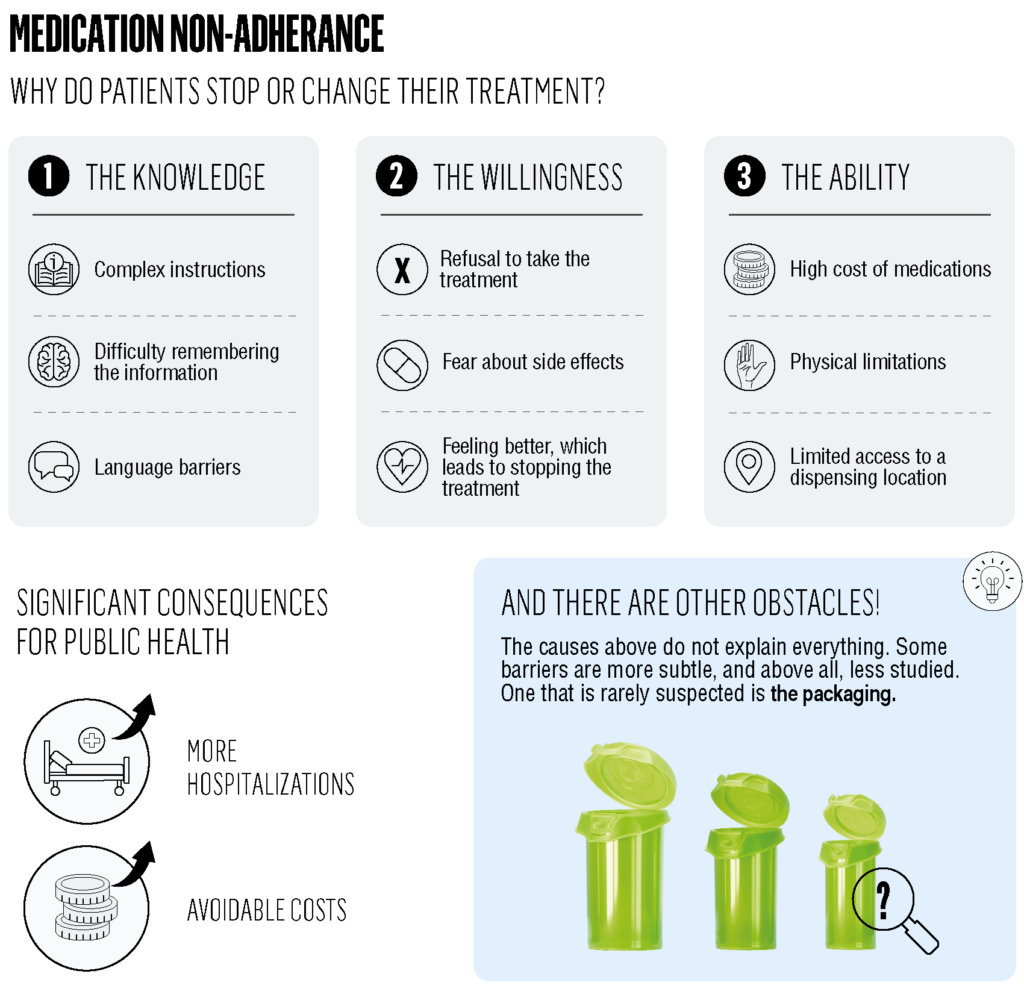
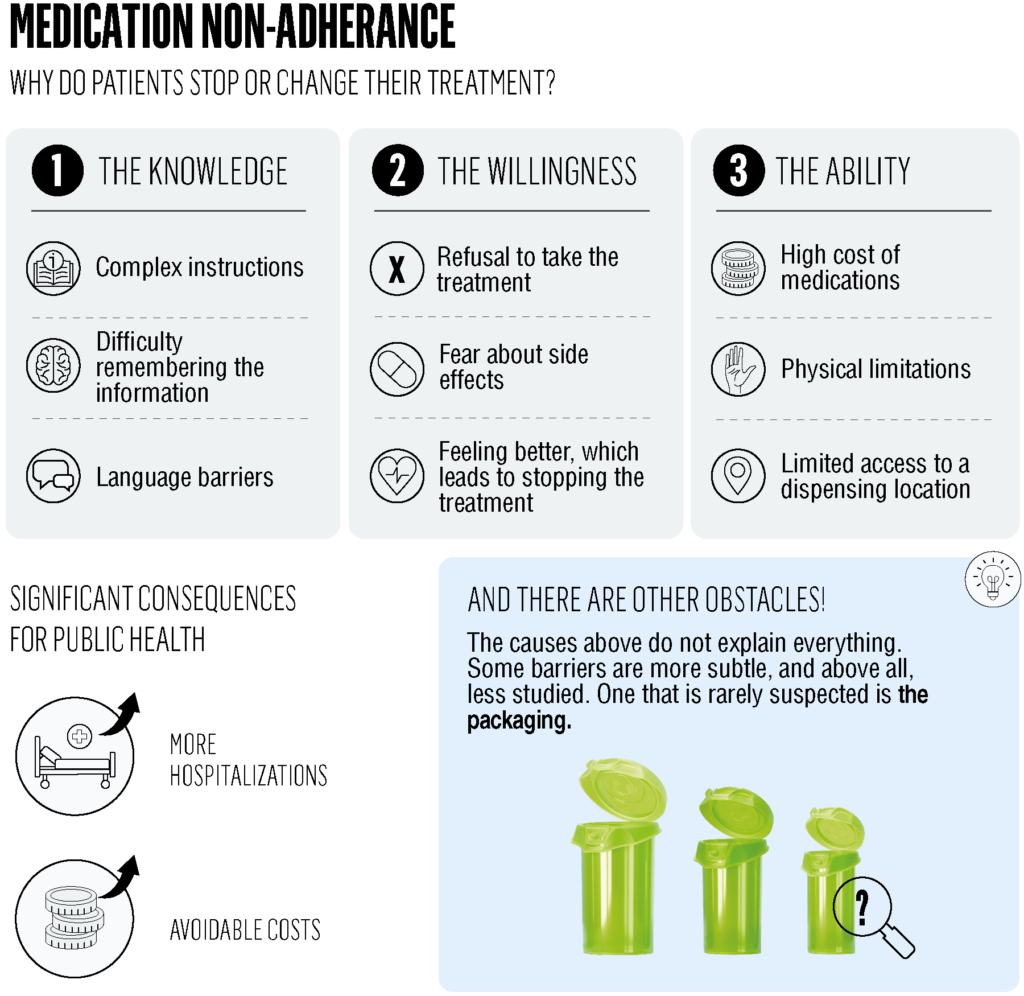
There are many reasons why patients stop or modify their treatment.
They generally fall into three main categories:
- Knowing: Difficulty understanding or remembering instructions.
- Wanting: Refusal of treatment, personal beliefs, fear or concern about side effects, or feeling better and deciding to stop treatment.
- Being able: Medication costs that are too high or physical limitations, such as reduced dexterity or difficulty accessing a pharmacy.
Medication non-adherence is a major public health issue. Interrupted or incomplete treatments can lead to more hospitalizations and avoidable costs for society as a whole.
But these factors do not tell the whole story. Some barriers are more subtle and, importantly, less studied.
One of them is rarely suspected: packaging.
Can packaging be a barrier to medication adherence?
In 2022, the international clinical geriatrics journal Age and Ageing published an article identifying difficulty opening medication packaging as a potential barrier to medication use.
The researchers specifically highlighted the challenges associated with medication vial closures. They need to be child-resistant while remaining sufficiently easy to open for older adults and people with reduced fine motor skills.
The safety-accessibility paradox
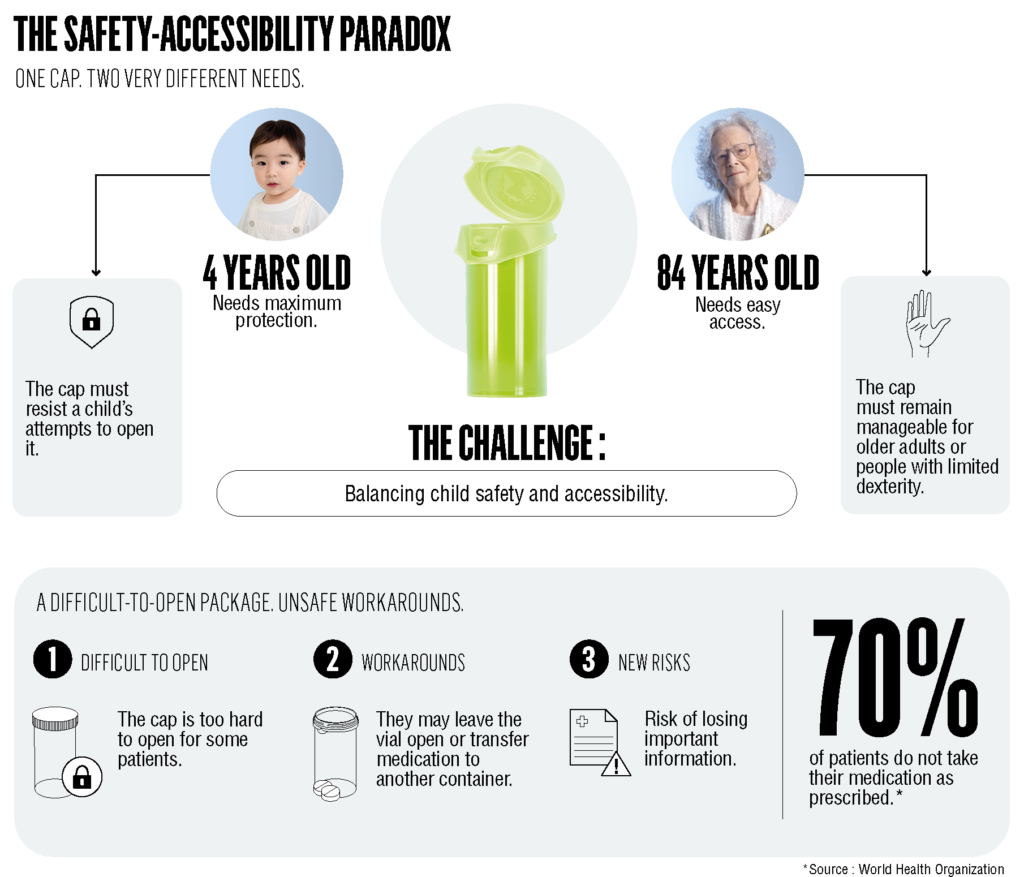
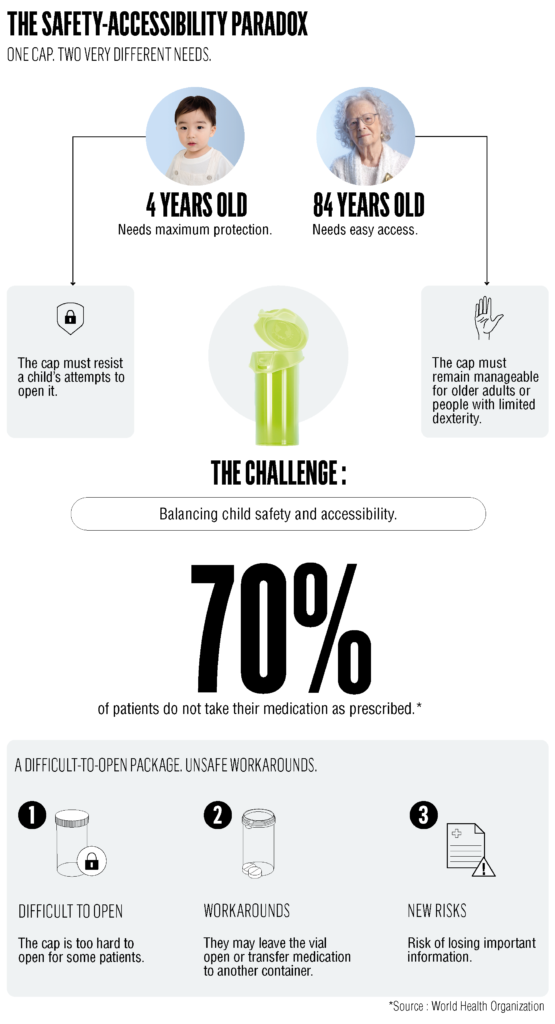
“Granny Syndrome” refers to the accidental poisoning of a child who ingests medication found among their grandparents’ belongings. Unfortunately, this is a common occurrence and highlights a well-known paradox for prescription medication packaging manufacturers.
When a child-resistant cap is too difficult to open, some patients may resort to unsafe workarounds, such as leaving medication vials open at all times or transferring their medication to another container that is too easy to open.
In doing so, they may:
- Lose the label containing important instructions or warnings.
- Increase the risk of accidental ingestion by a child or pet.
For too long, the delicate balance between safety and accessibility limited opportunities to improve medication vials. Their basic design remained largely unchanged for decades.
There’s a reason for this: designing pharmaceutical packaging means meeting several stringent requirements at once, including regulatory, safety and compliance requirements.
So, how can we improve the patient experience without compromising child safety?
And how can we make pharmacy workflows more efficient while maintaining a high level of compliance?
If this challenge remained overlooked for so long, it is because there was no obvious solution.
A medication vial closure needs to resist the efforts of a four-year-old while still being manageable for an 84-year-old.
Make it too difficult to open, and it can become a barrier for the patient.Make it too easy, and safety may be compromised.
Our solution
At EcoloPharm, this challenge led us to develop a dual-purpose closure that allows pharmacy teams to adapt medication accessibility to the patient’s needs while maintaining required levels of safety and compliance (CSA, FDA).
One of the solutions we developed is a medication vial with a dual-function cap that can be configured according to the patient’s needs. When appropriate, the pharmacist can quickly switch to an easy-open configuration without slowing down dispensing.
Preferences also vary from one pharmacy to another. To better accommodate different pharmacy workflows, we have developed a range of ergonomic opening mechanisms.
Different pharmacies, different preferences.
Medication adherence depends on many factors, several of which are beyond a pharmacist’s control. But some barriers can be avoided.
Pharmacy teams have opportunities to identify potential barriers to adherence. ISMP Canada recommends that community pharmacy teams ask patients to demonstrate how they plan to take a new medication. This approach helps confirm their understanding and identify potential difficulties before they return home.
That same attention can, and should, extend to the packaging. A vial that is difficult to open can create an avoidable barrier to medication adherence.
Packaging is obviously not the solution on its own, but it remains one part of the treatment experience that can be improved.
Packaging is part of the solution
Packaging alone cannot solve medication non-adherence, but it remains an important part of the treatment experience and one that can be improved.
As pharmacy moves toward more personalized care, medication containers should evolve too, with the needs of both patients and pharmacy teams in mind.
For pharmacy teams interested in exploring different approaches, compare the different types of medication vials available or try them directly in your pharmacy.
*Because there is no single method for determining whether medication is taken as prescribed, medication non-adherence remains difficult to measure precisely. Estimates therefore rely on different indicators and may vary depending on the condition, treatment and assessment method used.
Frequently Asked Questions
What’s the link between packaging and medication adherence?
Difficulty opening a vial may lead a patient to work around the problem by leaving the vial open or transferring the medication to another container. As a result, they may lose the label containing important instructions and warnings or compromise the stability of the medication.
Why are child-resistant vial caps difficult for older adults to open?
Because a vial cap must balance two competing needs: keeping children from opening it while remaining accessible to an older adult or someone with reduced fine motor skills.
Balancing safety and accessibility is one of the key challenges in medication vial design and has long limited opportunities for innovation.
How can a vial be made more accessible while maintaining child-resistant compliance?
Some approaches use a dual-purpose cap that can be configured according to the patient’s needs.
When appropriate, the pharmacist can quickly switch to an easy-open configuration without slowing down dispensing.
Does EcoloVial slow down dispensing?
No. The conversion to an easy-open configuration can be done quickly without adding unnecessary steps to the dispensing process or pharmacy workflow.
Can accessibility be adapted for each patient?
Yes. That is precisely the benefit of a configurable cap. Pharmacy staff can determine, based on the patient’s needs, whether to use the standard child-resistant configuration or the easy-open option.
The same product can therefore accommodate the needs of families as well as older adults and people with reduced dexterity.
What are the consequences of medication non-adherence?
Interrupted or incomplete treatments can lead to increased hospitalizations and avoidable healthcare costs, making medication non-adherence a major public health issue.
What types of medication vials does EcoloPharm offer pharmacies?
EcoloPharm designs prescription medication packaging solutions, including the EcoloVial line.These vials offer different ergonomic designs and opening mechanisms to accommodate pharmacy team preferences and patient needs.
Pharmacy teams cancompare the available cap options or try them directly in their pharmacy.

More Articles You Might Like

Why Conventional Prescription Vials End Up in Landfill
Standard prescription vials may be recyclable in theory, but they often end up in landfill. Find out why and how pharmacies can help.
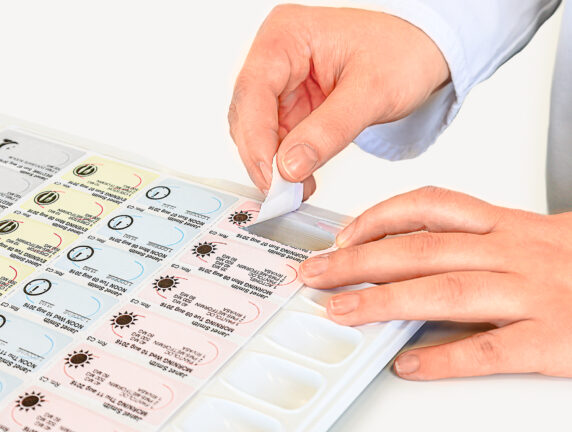
EcoPill Compliance Packaging: Step-by-Step Filling Guide
Practical guide to filling an EcoPill pill organizer in the pharmacy, from preparation to handoff to the patient. Discover the key steps to ensure accurate filling, consistent sealing, and compliant modifications, while reducing the risk of medication errors. This guide outlines best practices, common pitfalls to avoid, and tips to optimize verification and protect confidentiality. A rigorous method improves workflow efficiency and helps ensure safety, compliance, and quality of dispensing.

EcoloPharm wins its very first MERCURE
EcoloPharm has been awarded the prestigious “Employer of the Year” Mercure at the 2026 Mercuriades business competition.

EcoloPharm wins the “Employer of Choice” award
EcoloPharm is the proud winner of the Employer of Choice award at the 2026 Gala Illumina!
WE ARE PASSIONATE ABOUT SUSTAINABLE DEVELOPMENT.
We’re eager to meet new change agents who share our values with regard to sustainable development.
Do you have an inspiring idea you would like to share?