
Why Conventional Prescription Vials End Up in Landfill
Every day, your pharmacy dispenses hundreds of prescription vials. Most of them will never be recycled, whether patients place them in the recycling bin or the garbage.
The broader context does not help. In 2022, 5 million tons of plastic waste were discarded in Canada. Of that amount, only 6.5% was recycled.¹ Small prescription vials, which are often improperly sorted, are part of the problem.
Why do vials that are technically recyclable end up in the garbage?
What simple actions can make a difference?
Here are the main reasons standard prescription vials end up in landfill, and the actions your pharmacy can take.
Quick Navigation
- The Journey of a Standard Pharmacy Vial
- The Cap: A Small Piece That Makes a Big Difference
- The Vial Label: A Barrier to Recycling?
- Contaminated Packaging Won’t Be Recycled
- Two Important Steps in the Pharmacy
- Recycling Starts Long Before the Bin
- Frequently Asked Questions
The Journey of a Standard Prescription Vial
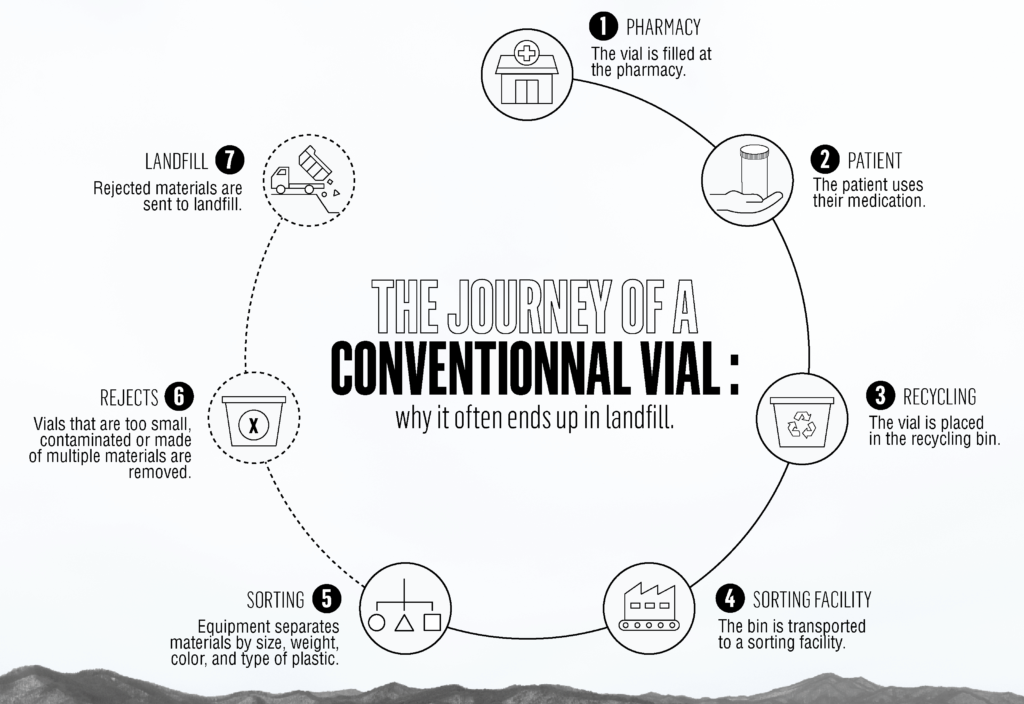
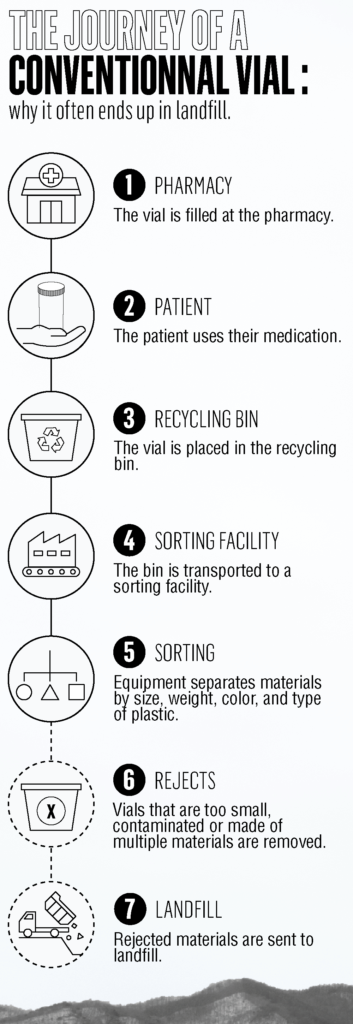
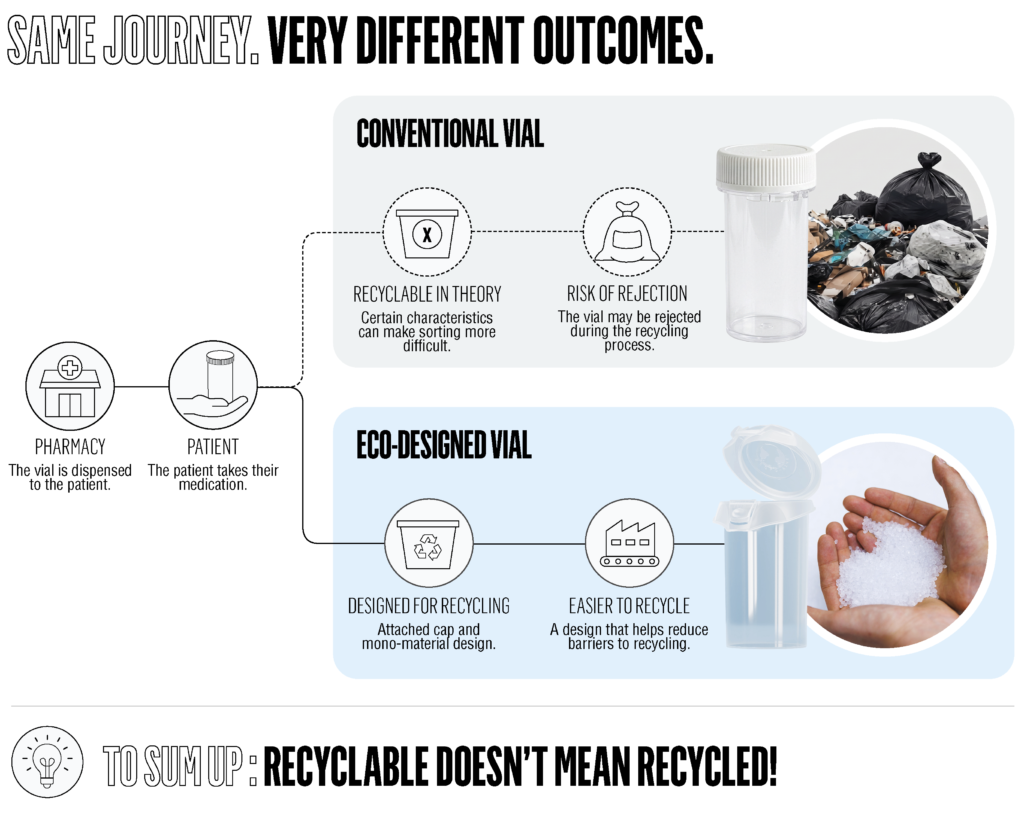
After use, a vial is ideally placed in the recycling bin and transported to a sorting facility, where it travels along a series of conveyor belts, where equipment separates materials according to their size, weight and composition. If the vial is too small, contaminated or does not meet recyclability criteria, it is diverted to the residual waste stream and ultimately sent to landfill.
The cap: small piece, big difference
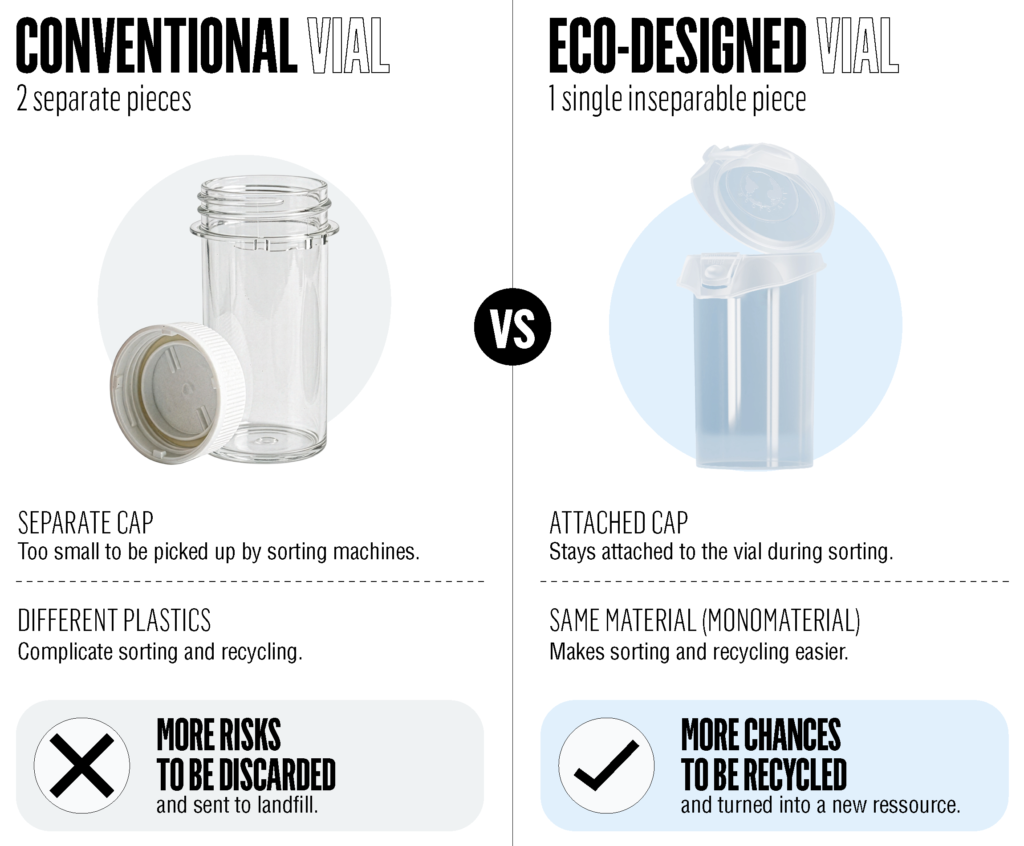
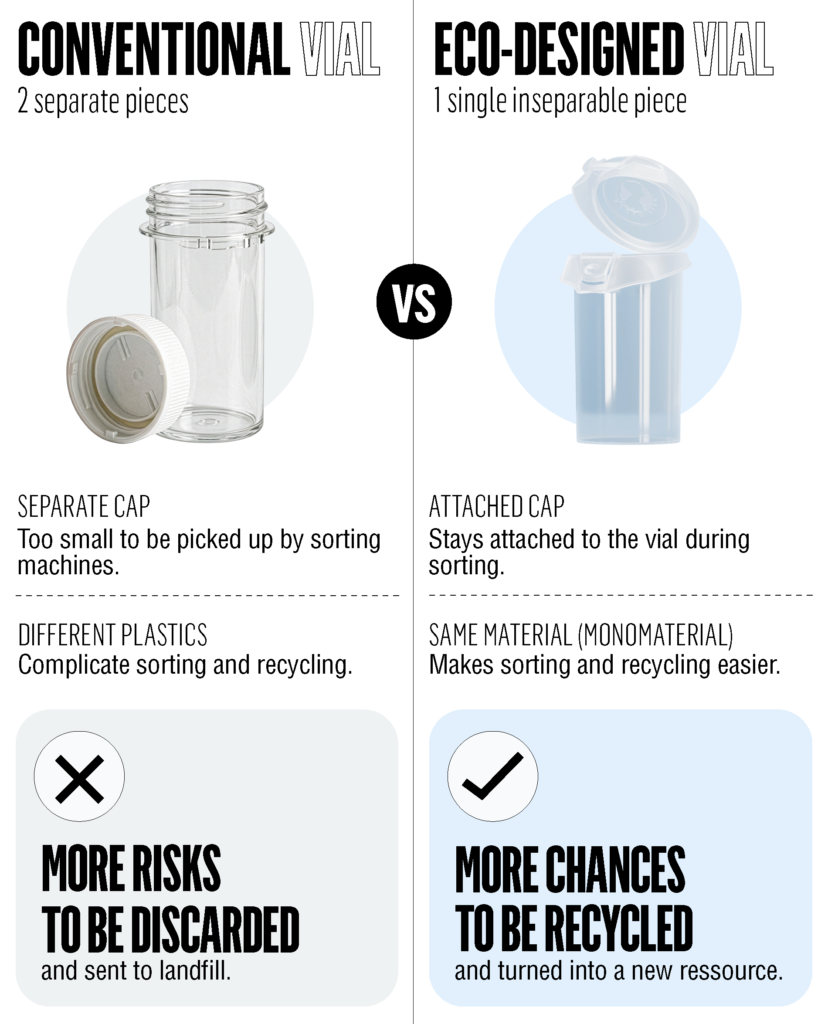
A cap that separates from its vial poses a challenge for sorting equipment: it is too small and too lightweight to be properly captured by the system. As a result, millions of caps end up in landfills every year.
Its composition can also affect its recyclability. When the cap is made from a different type of plastic than the vial, or is a different colour, sorting becomes more complex. The result? Once again, the cap ends up in landfill.
The good news? A simple solution, such as packaging designed to keep the vial and cap together, prevents them from separating and helps them move more easily through the sorting process.
The Vial Label: A Recycling Barrier?
Many patients see the label as a privacy risk because of the personal information it contains. As a result, many vials are thrown directly into the garbage.
Yet two simple actions can protect this information without sacrificing the recyclability of the packaging:
- Peel off the label.
- Or, even faster, black out the personal information with a marker.
In both cases, the vial can continue through the recycling process without compromising privacy.
Good to know: the label itself is not considered a contaminant, as it is removed during the material washing process at the sorting facility.
Contaminated Medication Vials Will Not Be Recycled
To be recycled, containers must be empty and clean. A small amount of leftover syrup or a forgotten tablet can contaminate the material and compromise the recycling process.
More specifically, medication residue can lower the quality of the material and cause it to be rejected. In Quebec, for example, the contamination rate of recycling bins was approximately 13% in 2025.²
Two Actions Pharmacies Can Take
Pharmacies have two concrete ways to help.
The first is to encourage patients to return unused or expired medications. As the Health Products Stewardship Association reminds us, these medications should be returned to a pharmacy, not thrown in the garbage or poured down the drain. This allows them to be handled safely, while the empty vial can follow its own recycling path.
Empty vials, on the other hand, must be disposed of by patients at home. This is where the second action comes in: choosing the right vial design.
A vial designed as a single piece can avoid the obstacles described above. No cap to lose, no mix of materials.
Organizations responsible for recycling in Canada are working to establish common ecodesign guidelines so that packaging can be truly recyclable, not just recyclable in theory. Choosing packaging designed for recycling from the outset means staying ahead of this shift. It is also at the heart of our approach to ecodesign.
In short, prescription vials end up in landfill for very specific reasons: their small size, their caps, the materials they are made from or medication residue. Simple actions can help address each of these challenges.
Recycling Starts Long Before the Bin
It starts with packaging design. EcoloVial combines the vial and cap into a single piece and uses just one type of plastic. These design choices help address the recycling barriers discussed in this article.
Discover EcoloVial or give it a try and see the difference it can make in your pharmacy.
FAQ
Are prescription vials recyclable?
In theory, yes. Most prescription vials are made from recyclable plastics.
However, their small size, separate caps and medication residue are all reasons they may be diverted from the recycling stream and sent to landfill instead.
Why can a recyclable vial still end up in landfill?
Several factors can prevent a vial from being recycled: a cap that becomes separated, a mix of materials, or medication residue. A vial can therefore be recyclable in theory without ever actually being recycled.
Why do prescription vial caps make recycling more difficult?
Caps are often too small to be recovered at sorting facilities. Some are also made from a different type of plastic than the vial, which can prevent them from being recycled.
Why do sorting facilities reject small pieces of plastic?
Sorting equipment is designed to handle objects within specific size ranges. Small pieces, such as caps separated from their vials, can fall through the sorting system and end up in landfill.
How can a one-piece vial make recycling easier?
A vial molded as a single piece eliminates the risk of losing the cap and limits the mixing of different materials, two important considerations for packaging recyclability.
How can a pharmacy reduce waste and support recycling?
Two actions can make a difference. First, encourage patients to return unused or expired medications to prevent medication residue from entering the recycling stream. This helps ensure that vials are empty and clean before reaching sorting facilities. Second, choose packaging designed with recycling in mind, such as a mono-material vial molded as a single piece.
What is a mono-material vial?
A mono-material vial is made from a single type of plastic. This simplifies sorting and recycling because different materials do not need to be separated.

D’autres articles qui pourraient vous intéresser

Medication Adherence: The Role of Packaging
Up to 70% of patients in Canada don't take their medication as prescribed. Packaging is a factor that's too often overlooked. Discover why.
EcoPill Compliance Packaging: Step-by-Step Filling Guide
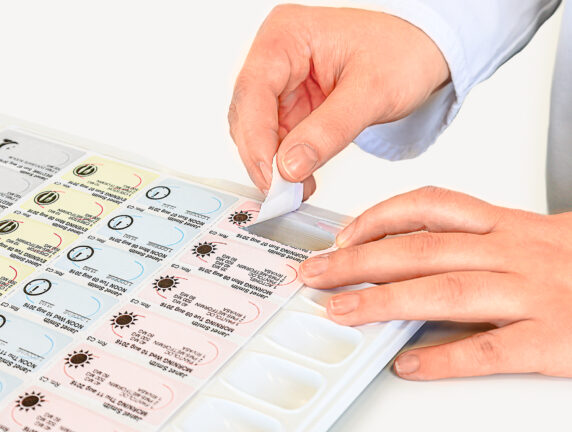
Practical guide to filling an EcoPill pill organizer in the pharmacy, from preparation to handoff to the patient. Discover the key steps to ensure accurate filling, consistent sealing, and compliant modifications, while reducing the risk of medication errors. This guide outlines best practices, common pitfalls to avoid, and tips to optimize verification and protect confidentiality. A rigorous method improves workflow efficiency and helps ensure safety, compliance, and quality of dispensing.

EcoloPharm wins its very first MERCURE
EcoloPharm has been awarded the prestigious “Employer of the Year” Mercure at the 2026 Mercuriades business competition.
EcoloPharm wins the “Employer of Choice” award
EcoloPharm is the proud winner of the Employer of Choice award at the 2026 Gala Illumina!
WE ARE PASSIONATE ABOUT SUSTAINABLE DEVELOPMENT.
We’re eager to meet new change agents who share our values with regard to sustainable development.
Do you have an inspiring idea you would like to share?